
Liturgical Prayer

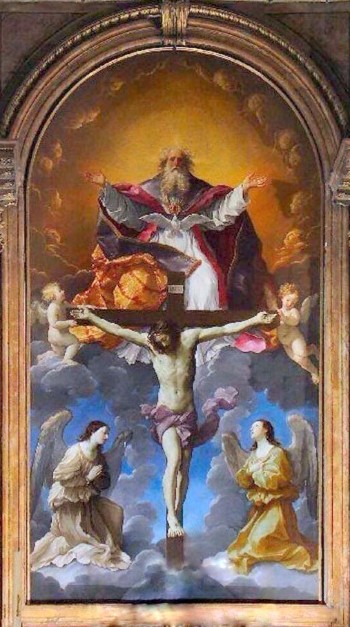 The Holy Trinity continues the work of our redemption through the sacred liturgy. It is there that we especially encounter Christ. Through the liturgy Christ continues to announce his Good news, to refresh us with his Body and Blood, and to unite us to his saving work by the life-giving action of the Holy Spirit. In this way he makes us a pleasing oblation offered to the Father. In the liturgy that we celebrate we mysteriously share in and are given a foretaste of the eternal liturgy in the heavenly Jerusalem.
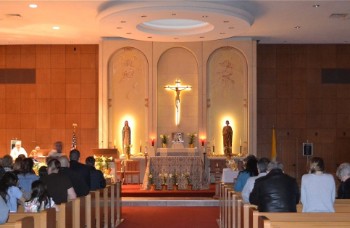 As members of the canonical life, we bind ourselves to the fulfillment of the Church’s great duty of praise and thanksgiving, thus placing ourselves at the service of the sacred liturgy. For the glory of God and the salvation of souls, we strive to reverently and attentively celebrate the liturgy. As we do so, we praise God in the midst of the Church as “a chosen race, a royal priesthood, a holy nation, a people he claims for his own” (1 Pt. 2:9). Through the liturgy we are enflamed with the compelling love of Christ who came as the servant of all.
While the members of each branch live separate community lives, we join together in worship and collaborate in the promotion of the liturgy in our apostolate.
Because this Order is dedicated to celebrating, living, and promoting the sacred liturgy, the liturgical days and seasons offer us a framework for the rhythm of prayer and life.
The Holy Eucharist
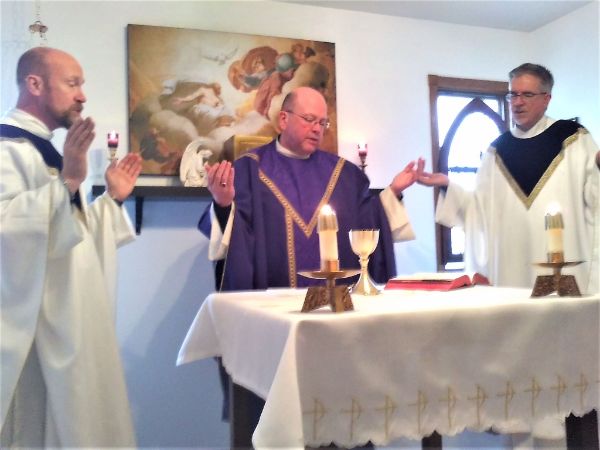 The Holy Sacrifice of the Mass is the center of all liturgical worship and the center of our community life. In the Eucharistic celebration the perfect glorification of the Most Holy Trinity is achieved, the work of our redemption is accomplished and the true meaning of our consecration is discovered. The Eucharist is the core of our lives and we participate in the Eucharistic Sacrifice daily.
By our baptismal priesthood, all our efforts, prayers and apostolic endeavors, our daily work, both mental and physical, our relaxation, the hardships and joys of life, all that we have, all creation, and especially our very selves, are meant to become spiritual sacrifices acceptable to God through Jesus Christ (cf. 1 Pt. 2: 5). These sacrifices - these gifts - are offered to the Father with love along with the Body and Blood of the Lord during the celebration of the Holy Sacrifice of the Mass. In this way we consecrate the whole world to God. The things we offer are received back transformed in this holy exchange of gifts.
In our communion with Christ, the Way, the Truth and the Life, we are strengthened in our faith, hope and love. As we share in the joy of the Eucharistic mystery and unite our own self-oblation to the redemptive action of Christ Our High Priest, we are bound as members of this community by the same aims of loving God and being servants to others. As a result, our community is transformed into a true brotherhood and sisterhood.
Besides the Mass, we foster a Eucharistic-centered life through periods of prayer before the exposed Blessed Sacrament and other exercises of piety in honor of this great mystery.
Liturgy of the Hours
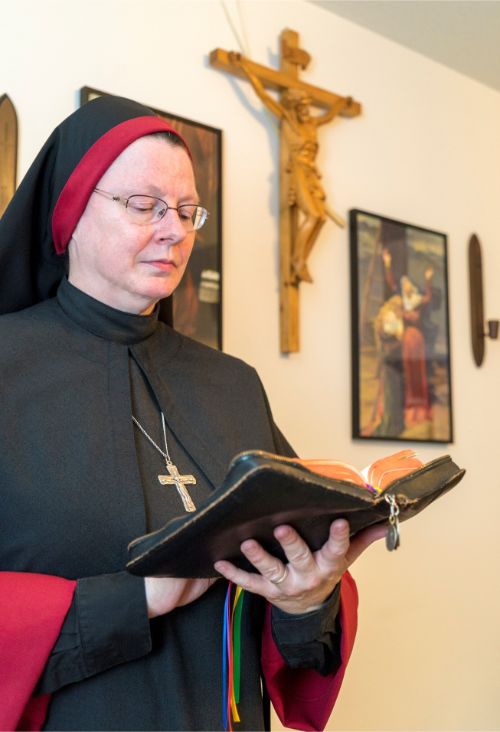
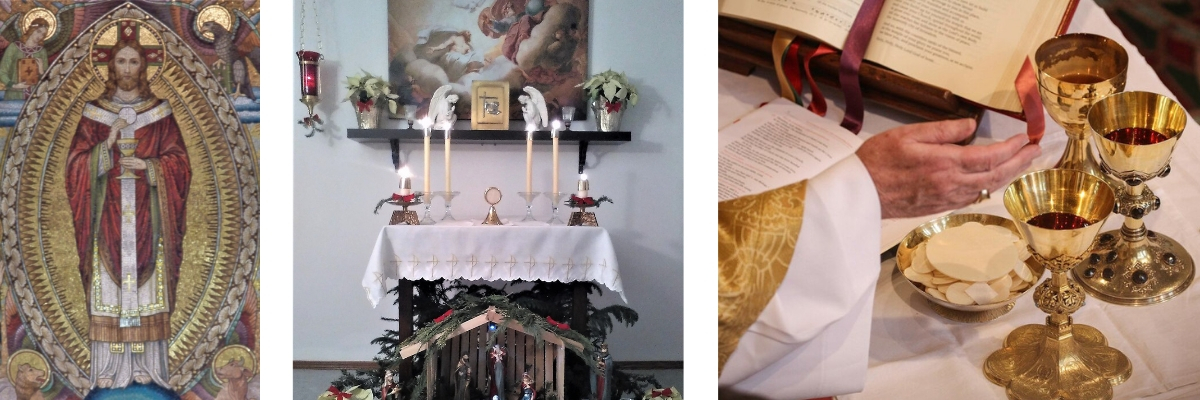
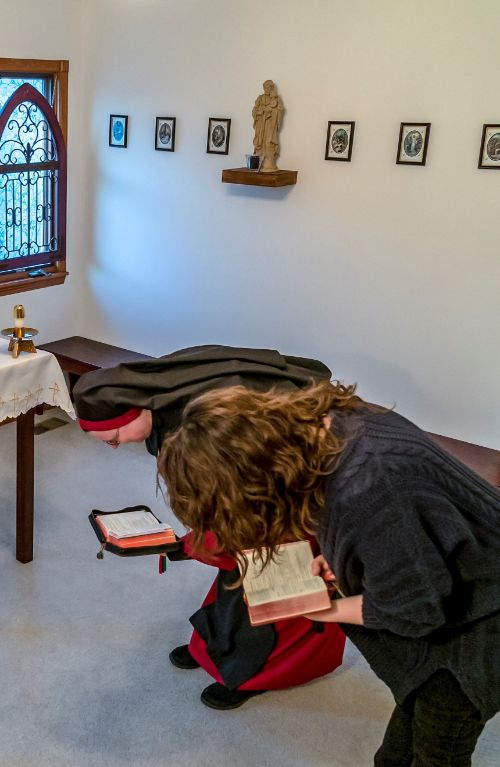 Going hand-in-hand with daily Mass is the daily Liturgy of the Hours, also known as the Divine Office. It is the public prayer of the Church celebrated at specific times throughout the day which the Church, in union with Christ her spouse, offers to the glory of God the Father. In this way the worship which is rendered to God through the celebration of the Eucharistic Sacrifice continues without ceasing. By the Liturgy of the Hours the entire course of the day with all its activities is sanctified through the praise of God. In this prayer we offer the Church's sacrifice of praise. We pray that this prayer of praise and supplication for God's holy people, rises before the throne of God "as incense in his sight.”
We pray the Hours according to the Roman Rite and in the form prescribed for the United States. Generally, the Servants of the Trinity celebrate all seven hours of the Divine Office. At this very early stage in the development of the community, circumstances may affect where and when, and the manner of the celebration. Since singing the liturgy is more in line with the nature of the Divine Office and can be a sign of a fuller and more profound union of hearts in carrying out the praises of God with one voice, we try to sing the Hours – at least the principal ones.
Other Liturgical Celebrations
Celebrations of God’s Word are encouraged, especially during Advent and Lent, and other occasions when it would be spiritually beneficial for the members. We also try to make ample use of the Church’s blessings to mark days of celebration, observe special occasions, and help in moments of need.